Pick a job with a payoff
The best opportunities have a clear input, a useful output and a way to recognise success. We keep the model’s role bounded and testable, so you know what you’re getting.
AI integration
Hobart software studio · Working across Australia
We build AI into business software and workflows where it does a measurable job, with the human review and fallback paths real work demands.
What's at stake
AI is genuinely good at reading, sorting, finding and drafting. Point it at the hours your team spends hunting for information or preparing routine responses, and it pays for itself quickly. Point it at everything, and you get a chatbot nobody trusts.
We start with the job, not the technology. If a fixed rule or better search does it more reliably, we’ll say so and save you the money. When AI is the right tool, we build it in with boundaries, review and a way to prove it’s working.
From the work
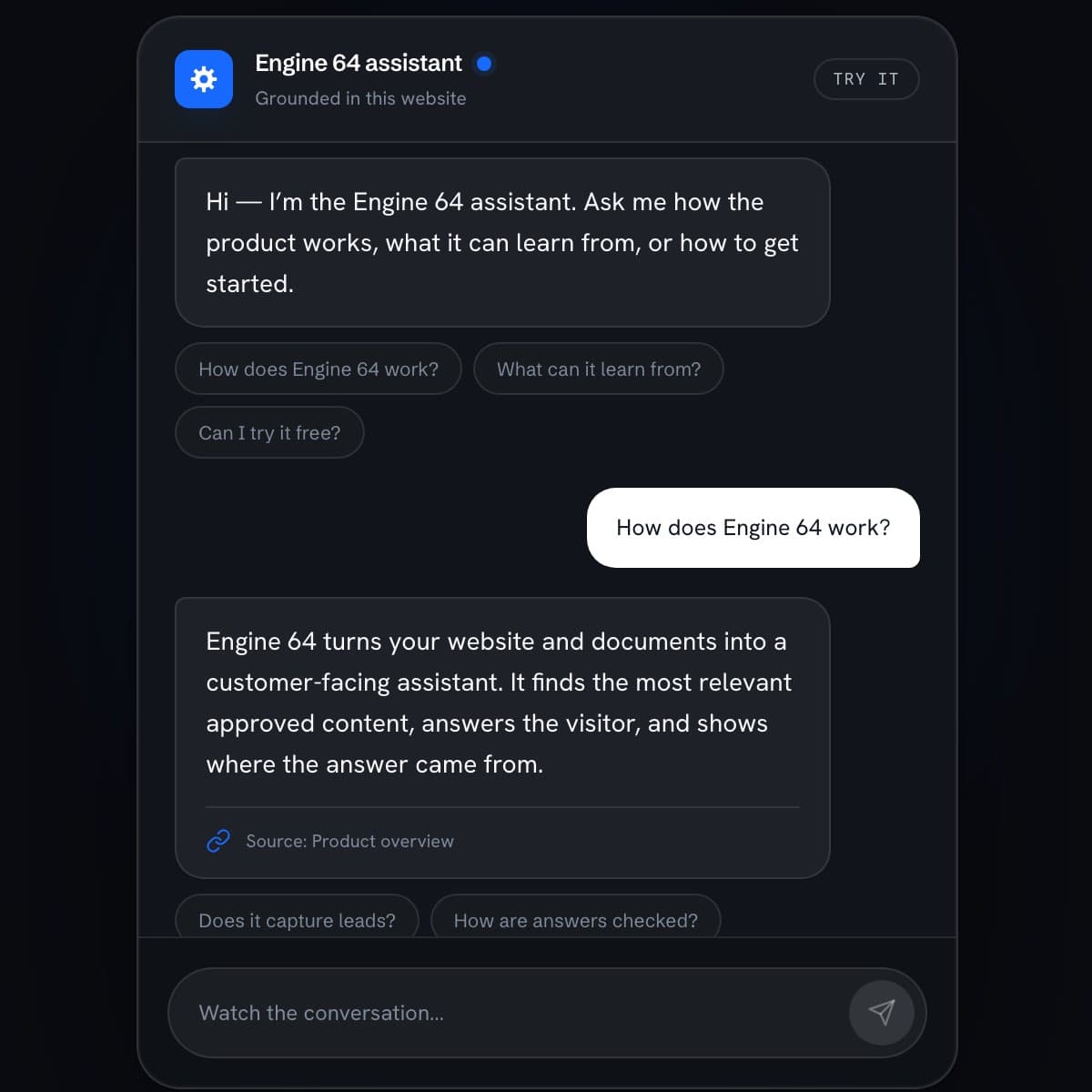
Our own product, Engine 64, builds an AI agent from a site’s existing pages and documents. It answers in the visitor’s words, cites the source behind every answer and hands over to a person when the conversation needs one.
See Engine 64What you get
How we work
The best opportunities have a clear input, a useful output and a way to recognise success. We keep the model’s role bounded and testable, so you know what you’re getting.
The interface shows what the system did, where the information came from and when a person needs to check the work. A confident sentence is never treated as proof of correctness.
We test representative examples, edge cases and failure consequences, weighing quality, speed, privacy and cost together. The feature ships when it holds up in daily work, not when the demo looks good.
Is this you?
Straight answers
It depends on what a wrong answer costs. Low-risk assistance may only need an easy correction path, while anything touching customers, money or commitments gets explicit review or stronger deterministic controls. We match the guardrails to the stakes.
Yes, and that’s where it gets genuinely useful. A grounded system retrieves relevant material from your approved content and prepares an answer with the sources shown. Permissions, freshness and fallbacks still need real design work, and they get it.
You’ll see it measured. We define representative tasks and expected outcomes, then evaluate accuracy, failure modes, speed and cost against them. The bar for shipping reflects the job and the oversight available, not the hype.
Start a conversation
The first conversation is free, the language is plain and there's no obligation. You'll leave with a clear recommendation, whether or not we end up working together.
Start your project